• Which the release of FS2020 we see an explosition of activity on the forun and of course we are very happy to see this. But having all questions about FS2020 in one forum becomes a bit messy. So therefore we would like to ask you all to use the following guidelines when posting your questions:

    • Tag FS2020 specific questions with the MSFS2020 tag.
    • Questions about making 3D assets can be posted in the 3D asset design forum. Either post them in the subforum of the modelling tool you use or in the general forum if they are general.
    • Questions about aircraft design can be posted in the Aircraft design forum
    • Questions about airport design can be posted in the FS2020 airport design forum. Once airport development tools have been updated for FS2020 you can post tool speciifc questions in the subforums of those tools as well of course.
    • Questions about terrain design can be posted in the FS2020 terrain design forum.
    • Questions about SimConnect can be posted in the SimConnect forum.

    Any other question that is not specific to an aspect of development or tool can be posted in the General chat forum.

    By following these guidelines we make sure that the forums remain easy to read for everybody and also that the right people can find your post to answer it.

FSXA Airbus A350 XWB

I actuallly just found a problem... it seems that there's a discrepency between the aircraft delivered and the aircraft used for testing....

On the nose the details about the probes
You see on the test aircraft (MSN 1 - 5) the probes seem to be like this:

1600x1200_1418316757_A350_XWB_MSN3_NOSE_CLOSE_UP.jpg


On the nose there is one tube and two flat sensors (witch seem to be twisted on most aircraft) and two hooks (?)
On the sides there is another tube (down low) and one small tube (I assume for testing purpose.

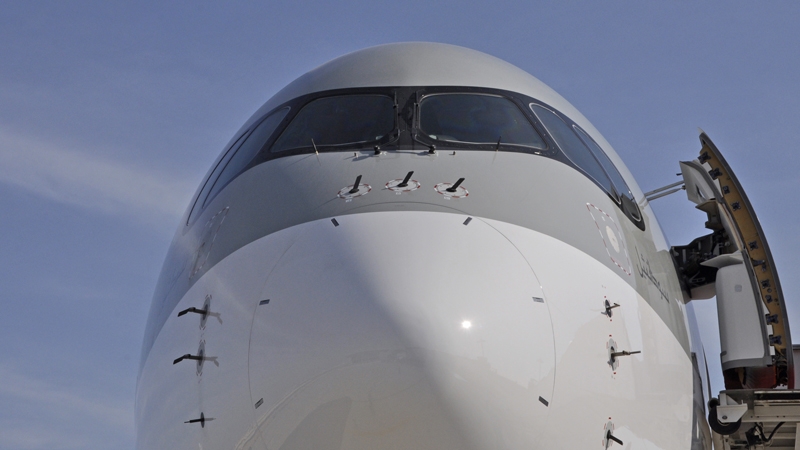
On the Qatar A350s though:

qr-a350-nose-closeup.jpg


Three flat sensors on top (see what I mean when I say they're twisted)

I don't know witch to take for the development...
 
Last edited:
In most cases, a production version is a bit different from the prototype. The things you're addressing here, are aerodynamic sensors, like static ports, pitot tubes and AOA vanes. On the prototype, there are always a bit more of these, just for testing purposes.
 
In most cases, a production version is a bit different from the prototype. The things you're addressing here, are aerodynamic sensors, like static ports, pitot tubes and AOA vanes. On the prototype, there are always a bit more of these, just for testing purposes.

I figured (e.g. those things on the side of the tubes on top of the prototype)
But it seems some stuff, like the tubes and the flat-tubes have been mixed in the production version...
Also those flat tubes seem to be twisted (or so to say not alligned with the flight direction) on most aircraft...
 
As far as I can observe from the photos above, nothing is mixed, only the upper pitot tubes are gone and the lower vanes are gone.
 
As far as I can observe from the photos above, nothing is mixed, only the upper pitot tubes are gone and the lower vanes are gone.

Am I being blind? you right that in this instance only one thing seems to seperate the Prototype from the Production version... In the image I used initially though it seemed to be more different (atleast the pitot tubes)

IMG_6205.jpg


explaination I'm then guessing would be that the above image is MSN003 and the image in the previous post perhaps MSN004 or MSN005, so they might have changed it after some test flights... Anyway I thought I was going mad, modeling things that wheren't even there, but now I understand! :)
 
In most cases, every prototype is build for specific tests, AFAIK. I recommend that you should always seperate the production version from the prototype.

Nice observations concerning my T.5 development, just to make you afraid :P

- The prototype was far different from the final version (alternative rudder arrangement, different interior, other pitot tube location, to name but a few)
- After the testing period was finished, the prototype (registred 850) was transformed into a normal production version. Prototype gone, but probably the details weren't changed, confusing my references.
- We have very few photographs of the interior, of which I think 50% is taken in the prototype. I was only able to seperate these different sources first after identifying the pilot (mr. Emil Meinecke, has a very reminiscent face), only then I could list the differences and interpret the handbook correctly.
- Changes in configuration were also made during the life span.
- Fokker made detailed arrangement drawings in the very beginning, so it is essential to look at the drawing date. 1937 drawings are rubbish therefore.

:D

Today, a lot of things are standardized and automized (production processes), so you should be glad that it isn't the mess like in the old days.

Have fun:D
 
oh dear! Amazing thaat you can still make such a great product @Dutcheeseblend ! I don't think I would be able to to all of that just from recognizing faces and such....
 
So I made a bit of a plan to do the details. So I'll probably refer to numbers of detail, in total 7, witch are parts of the aircraft worked from front to back...
So part 1/7 of details is done (nose section, without the gear)
I don't know if I might still have to scale the probes a bit...

nose_zpsn6zzcnax.png


Thoughts?
 
looking great I guess. but something doesnt look like the origin. may the form of the nose from windows downstairs, or it is just the perspective ;)

Love to see the A350 growing :)
 
looking great I guess. but something doesnt look like the origin. may the form of the nose from windows downstairs, or it is just the perspective ;)

Love to see the A350 growing :)

I'll see if I can align the view with a RL image to compare
 
This might be the best to get out of that:

a350_xwb_msn005_take_off_1.jpg


compare%204_zpssdpwhg0p.png


Now the winglets aren't right (they should be sharper)
 
I actuallly just found a problem... it seems that there's a discrepency between the aircraft delivered and the aircraft used for testing....


1600x1200_1418316757_A350_XWB_MSN3_NOSE_CLOSE_UP.jpg


On the nose there is one tube and two flat sensors (witch seem to be twisted on most aircraft) and two hooks (?)
On the sides there is another tube (down low) and one small tube (I assume for testing purpose.

The three on top are not 2 flat sensor and one tube, but are three identical sensors, they act like a flag in the wind, so if the aircraft is stationary they can be found twisted in various directions. When the aircraft is moving they keep straight with the wind direction, so they measure the side-slip angle. This is common in a test aircraft, less common in a production aircraft, moreover they are three and seem strange, but maybe something related to a better control of the plane by the computers.

The two "hooks" are Total Air Temperature sensor, basically to better evaluate Mach number.

Other sensor on the side are: uppermost is a Pitot tube, then a couple of Angle of attack sensors (similar to the upper side-slip sensors) and finally maybe an ice detector.
 
That's actually quite interesting, so they just align with the fusalage when the aircraft is at speed?

I already figured they had to be modules, because you can't change from a tube sensors to flat sensors without them doing the same thing...
The layout of the A350s probes are like this:

A350Probes_zps123a792c.jpg
 
Both the pilot and the copilot have their own static and pitot port.
To maintain redundancy, every Flight Computer (I believe a modern airliner has three of them) needs to have its own sensor.

The flags are angle measurement sensors. They measure alpha (AoA) and beta (sideslip).
 
Both the pilot and the copilot have their own static and pitot port.
To maintain redundancy, every Flight Computer (I believe a modern airliner has three of them) needs to have its own sensor.

The flags are angle measurement sensors. They measure alpha (AoA) and beta (sideslip).

True, the aircraft also has two more sensors just unbeneeth the two main front windows, witch I assume are related to temperature measurement since they're also feautured on the production version. Anyway I sorted it out, removed the tubes place the Flags and am once again happy with the work done...
 
thx for your pics. in my opinion the nose is a bit to sharp. but dont know exactly. looking great.

Oh, I noticed, that I forgot to send this post to you yesterday :D Could be the perspective, indeed
 
thx for your pics. in my opinion the nose is a bit to sharp. but dont know exactly. looking great.

Oh, I noticed, that I forgot to send this post to you yesterday :D Could be the perspective, indeed

I think that's indeed it, sometimes I just don't work the lens option and these things then happen. But since I didn't change the nose since the last in-FS screenshot I posted here it should be allright.... Thanks for looking out for these kinds of things though ;)
 
Back
Top