
• Which the release of FS2020 we see an explosition of activity on the forun and of course we are very happy to see this. But having all questions about FS2020 in one forum becomes a bit messy. So therefore we would like to ask you all to use the following guidelines when posting your questions:

    • Tag FS2020 specific questions with the MSFS2020 tag.
    • Questions about making 3D assets can be posted in the 3D asset design forum. Either post them in the subforum of the modelling tool you use or in the general forum if they are general.
    • Questions about aircraft design can be posted in the Aircraft design forum
    • Questions about airport design can be posted in the FS2020 airport design forum. Once airport development tools have been updated for FS2020 you can post tool speciifc questions in the subforums of those tools as well of course.
    • Questions about terrain design can be posted in the FS2020 terrain design forum.
    • Questions about SimConnect can be posted in the SimConnect forum.

    Any other question that is not specific to an aspect of development or tool can be posted in the General chat forum.

    By following these guidelines we make sure that the forums remain easy to read for everybody and also that the right people can find your post to answer it.

scenProc feature roadmap

arno

Administrator
Staff member
FSDevConf team
Resource contributor
Messages
34,328
Country
netherlands
2017.jpg
The end of 2016 is fast approaching, so it’s the time of the year to look back a bit on the last year and look ahead a bit to 2017 as well. For scenProc the last year has been very exiting, with a lot of ideas I had in my head coming to life. But I should also say directly that as users you haven’t seen much from this yet, because most of the new features are currently in a kind of alpha phase and are being tested in a project I’m involved with. In 2017 I hope that these new features will also start to move to the development release. Although I do not have a clear release plan for that in mind yet. But let me use this blog post to shed a bit of light on the possible future of scenProc, by describing some of the things I’m working on.

XML bridges

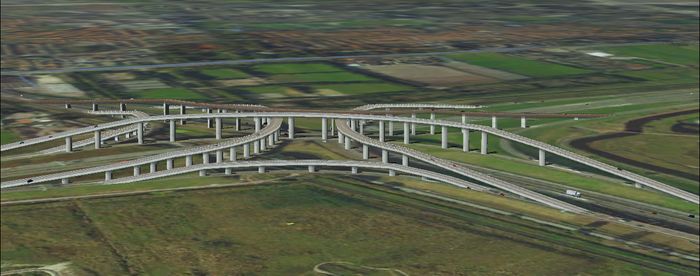
Currently scenProc can place XML scenery objects and effects for you. But I have been experimenting with placing XML bridges as well. The idea is that you use line vector data to generate such bridges automatically. The current results are quite interesting already, as you can see in the screenshot below.
pcp.jpg


Terrain vectors

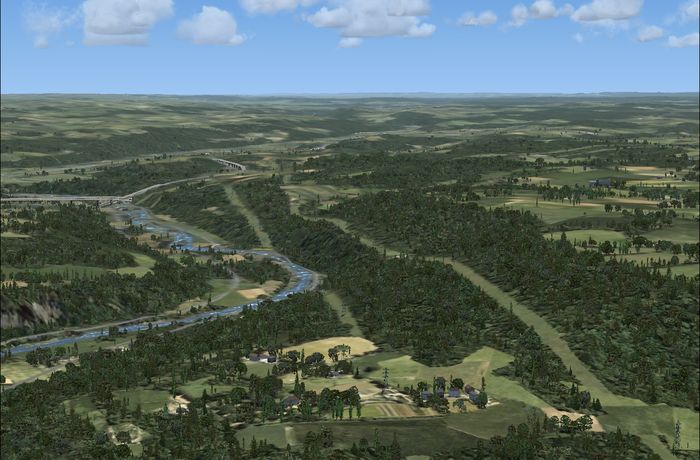
A second area that I have been working on is the generation of terrain vector scenery using shp2vec. Since scenProc can already process geographical vector data the step to shp2vec is not that big. And using the filtering functionality of scenProc you can then select which data should be used for the different terrain vector types. Below is a screenshot of a test area in Luxembourg that has been populated with terrain vectors using scenProc.
tvec.jpg


Photoreal scenery

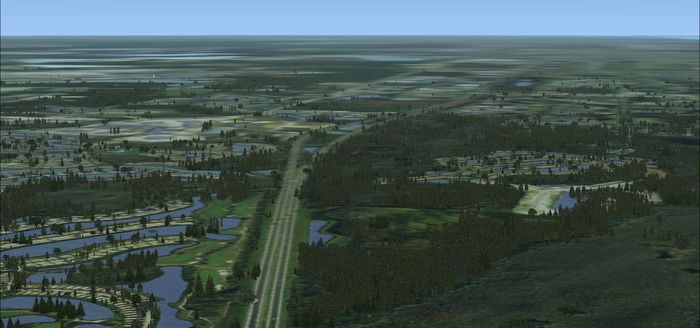
The main feature of scenProc has always been to generate autogen, but wouldn’t it be nice if you could generate the photoreal scenery as well? I have been working on exporting photoreal scenery using resample. Based on vector data scenProc can generate the water and blend masks for me and I have implemented basic colour corrections. I hope to do more colour correction stuff, for example for seasons or night versions. The image below is an example of a photo scenery made by scenProc (and autogen detected by scenProc).
photoreal.jpg


Big area processing

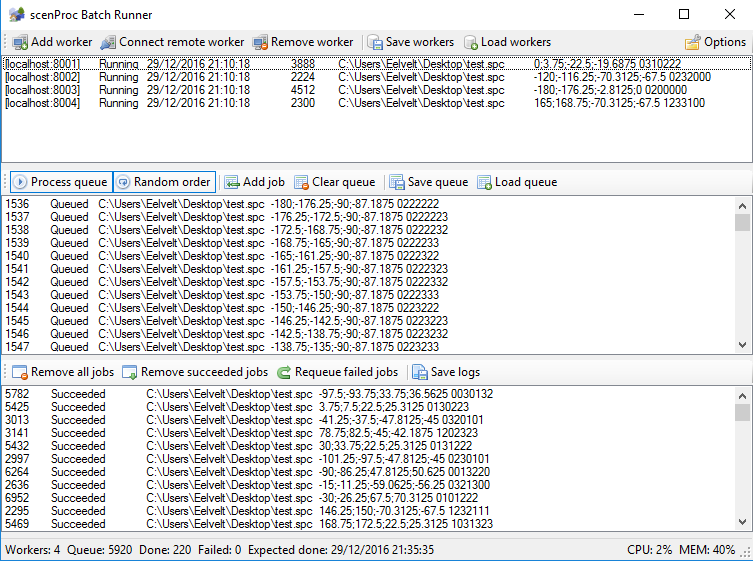
The last area I’m working on is improvements for processing big areas. With Nantucket I did detection of vegetation, but wouldn’t it be cool to also detect the buildings? And Nantucket is “only” 120 km² in size. So how to scale things up if you want to process an area of let’s say 1500 times that size? I’m working on new features to run multiple scenProc instances in parallel to process such big areas and ideally I hope to distribute it over multiple machines as well. And of course the feature detection itself needs some optimisation to make it scale better. Below is a screenshot of the batch runner tool I’m working on for this parallel processing.
sbr.png


So as you can see there are a lot of interesting ideas that I have started working on and that will hopefully become reality in 2017. But I can’t promise when or in exactly which form the different features will end up in the development release. At least it shows in which direction I’m thinking.

Continue reading...
 
Amazing... the XML bridges example looks impressive and the building detection features are of special interest to me.

I wish for you clarity of thinking for your programming in 2017 and beyond!
 
wow nice things to look forward to :)
colour correction and seasonal PR generation would of course be fabulous.
 
I read somewhere that you were looking at having Scenproc detect buildings in PR similar to the way Autogen vegetation is done at the moment. If I can suggest that it may make things easier or for more accurate detection if the algorithm might have the option to use use a GIS point data file as a 'hint' in the detection process. Some places don't have outline data but do have points representing the structures with data on the type of structure (Type, direction/rotation, etc). Scenproc could use this as a seed point or detection hint to detect the outline on the PR?

The LISTMap data from the Tasmanian Government has some samples I could furnish you with.

Just an idea.

cheers

Braedon
 
Resurrecting a year old thread, are any of the mentioned features closer to reaching the SSD's of us mere mortals please? :p
 
Hi,

All of them have progressed quite well actually in the last year. They are nearly finished and being used in a private project already.

The only BUT is that I haven't decided yet when and in which form they will go into the development release. Since they are used in a private project for the moment I have promised the other developers I work with to keep them under the hood for a while.
 
Hi,

For the area I'm working on footprints became available, so I didn't continue on building detection.
 
It’s a more complex problem as buildings can be various colours and shapes. Using Scenproc detection alone would be hard. There are other machine learning algorithms out there like CCN that might work, but one would need quite powerful cpus/gpus to get the job done not to mention long processing times. As far as I know, even today, there has been limited success to making this work perfectly for people that actually work with satellite imagery. I read an interesting article on medium.com where a guy used Keras to detect ships in the Sisco Bay, which worked well, but it would be much harder detecting, say houses, in large, dense, urban areas


Sent from my iPhone using Tapatalk
 
Oh, that's sad... That was the most anticipated feature for a long time for me...
I have made improvements to the feature detection, which might also help for buildings. I just haven't tested them with buildings and they are not yet in the development release.
 
Back
Top