
-
Which the release of FS2020 we see an explosition of activity on the forun and of course we are very happy to see this. But having all questions about FS2020 in one forum becomes a bit messy. So therefore we would like to ask you all to use the following guidelines when posting your questions:
- Tag FS2020 specific questions with the MSFS2020 tag.
- Questions about making 3D assets can be posted in the 3D asset design forum. Either post them in the subforum of the modelling tool you use or in the general forum if they are general.
- Questions about aircraft design can be posted in the Aircraft design forum
- Questions about airport design can be posted in the FS2020 airport design forum. Once airport development tools have been updated for FS2020 you can post tool speciifc questions in the subforums of those tools as well of course.
- Questions about terrain design can be posted in the FS2020 terrain design forum.
- Questions about SimConnect can be posted in the SimConnect forum.
Any other question that is not specific to an aspect of development or tool can be posted in the General chat forum.
By following these guidelines we make sure that the forums remain easy to read for everybody and also that the right people can find your post to answer it.
You are using an out of date browser. It may not display this or other websites correctly.
You should upgrade or use an alternative browser.
You should upgrade or use an alternative browser.
FSX Spaceflight dynamics module for FSX
- Thread starter Misho
- Start date


- Messages
- 1,057
- Country

Shroud jettison before stage separation?
Good eye! Which Stage? I did make a booboo, ESMP panels are jettisoned first, then LAS shroud. Then, quite a bit later, ICPS/Orion separation from Core stage occurs. . That's okay, easily fixed, sometimes I find errors in NASA's own videos


Heretic
Resource contributor
- Messages
- 6,830
- Country

Good eye! Which Stage? I did make a booboo, ESMP panels are jettisoned first, then LAS shroud. Then, quite a bit later, ICPS/Orion separation from Core stage occurs. . That's okay, easily fixed, sometimes I find errors in NASA's own videos
I thought the ESMP panels are scructurally relevant. Unless, of course, they're to be recycled, making early separation the better option.
- Messages
- 1,057
- Country
I thought the ESMP panels are scructurally relevant. Unless, of course, they're to be recycled, making early separation the better option.
I don't believe they are. They seem to serve only as a protective shroud for the Orion SM solar panels, which I would assume are rather fragile. The connection between Orion SM and ICPS is structural.
- Messages
- 1,057
- Country
OMFG :O Misho, you did itCongratz
Start assembling material for Guayana launch facilities scenery


- Messages
- 1,057
- Country
Hi everyone!
I am testing space->atmospheric transition... basically, a switch from FSX SpacePort flight model to FSX's own, internal flight model (that we all have learned to love and respect in some way). This will determine if it is possible to use FSX's flight model for modeling winged spacecraft, such as Space Shuttle, Buran, and DreamChaser.
For that, I need an add-on aircraft, freeware or payware, that has a good, if not excellent, subsonic/trans-sonic/super-sonic/hyper-sonic characteristics and performance.
Can anyone suggest such an add-on aircraft? Perhaps Xtreme Prototypes X-15?
I am testing space->atmospheric transition... basically, a switch from FSX SpacePort flight model to FSX's own, internal flight model (that we all have learned to love and respect in some way
). This will determine if it is possible to use FSX's flight model for modeling winged spacecraft, such as Space Shuttle, Buran, and DreamChaser.For that, I need an add-on aircraft, freeware or payware, that has a good, if not excellent, subsonic/trans-sonic/super-sonic/hyper-sonic characteristics and performance.
Can anyone suggest such an add-on aircraft? Perhaps Xtreme Prototypes X-15?

- Messages
- 1,057
- Country
Some thoughts on the future of FSX SpacePort and the new FS2020:
Analysis of what FS2020 developers are revealing
As many of you may know by now, Microsoft has announced the successor to the highly acclaimed FSX, along with the series of legacy Flight Simulators derived from FSX. The new simulator will be titled (appropriately) FS2020, (or, FS dos equis, for FSXX, as some simmers have started calling it ). We have been following with great interest the progress of the development, and we tried to scoop technical details that might pertain to what hopefully will be a follow up to FSX SpacePort - a version compatible with FS2020.
While the visuals are undeniably stunning, what MS has shown off so far was within atmosphere, where spaceflight dwells for mere minutes. On October 24th, MS has posted the latest development video, where they describe the weather system in FS2020. In it, there are a few quick video sequences of weather from a very high altitude, and, to our delight, a sequence from orbital altitude! Let's take a look at what they reveal:
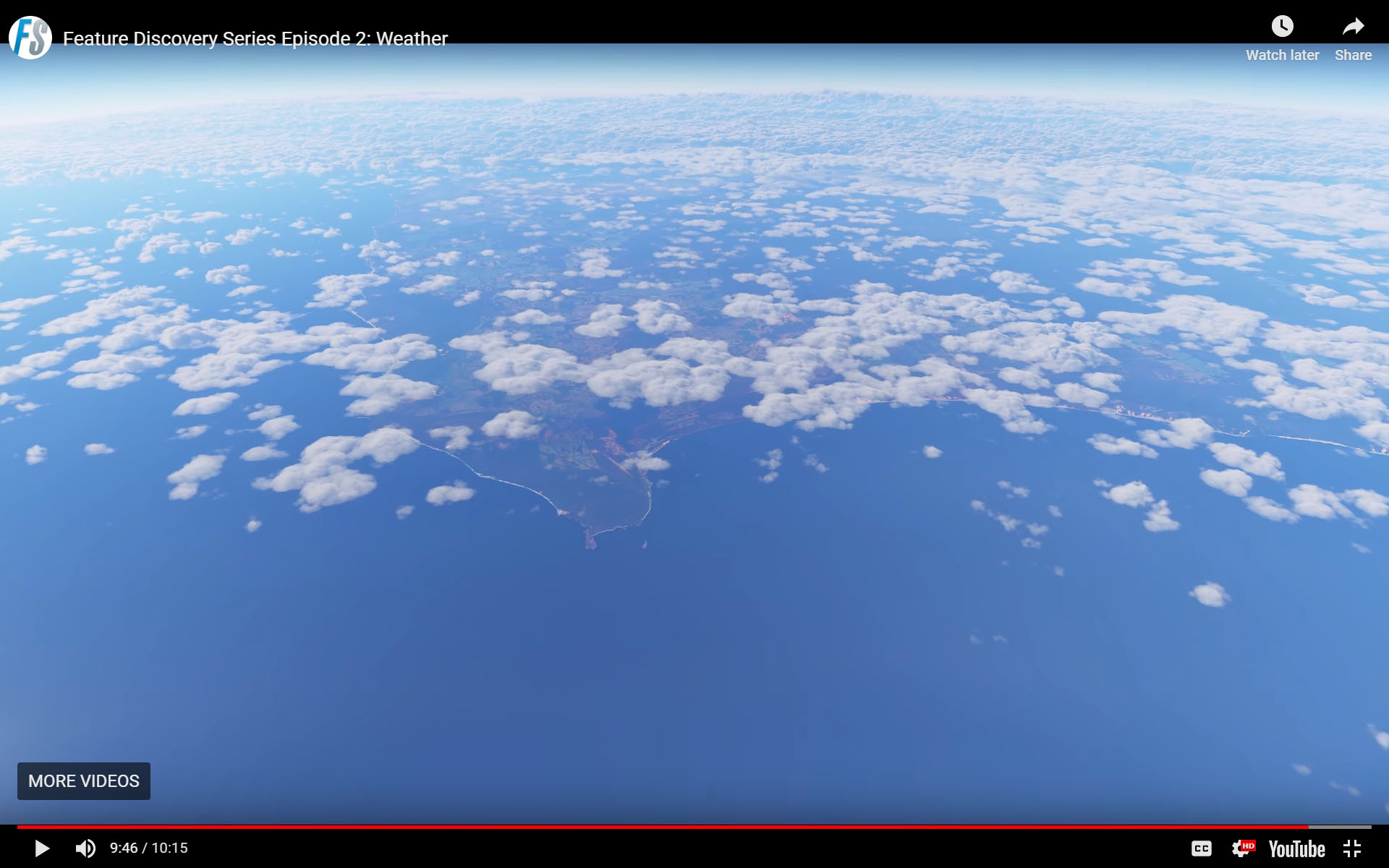
This first shot (above) is taken from a very high altitude, perhaps 20 to 30 km, and it shows a visual acuity far into the horizon. This is great from the aspect that the weather seems to have a lot bigger coverage than it had in FSX, where above 30 or so km, you can clearly see a "box" of weather (clouds) under the spacecraft. At orbital heights, The weather has to be turned off because it is just a small patch close to the ground that follows spacecraft, and the rest of the planet has no weather at all. We were always unhappy with how this looked and were searching for alternate solutions.
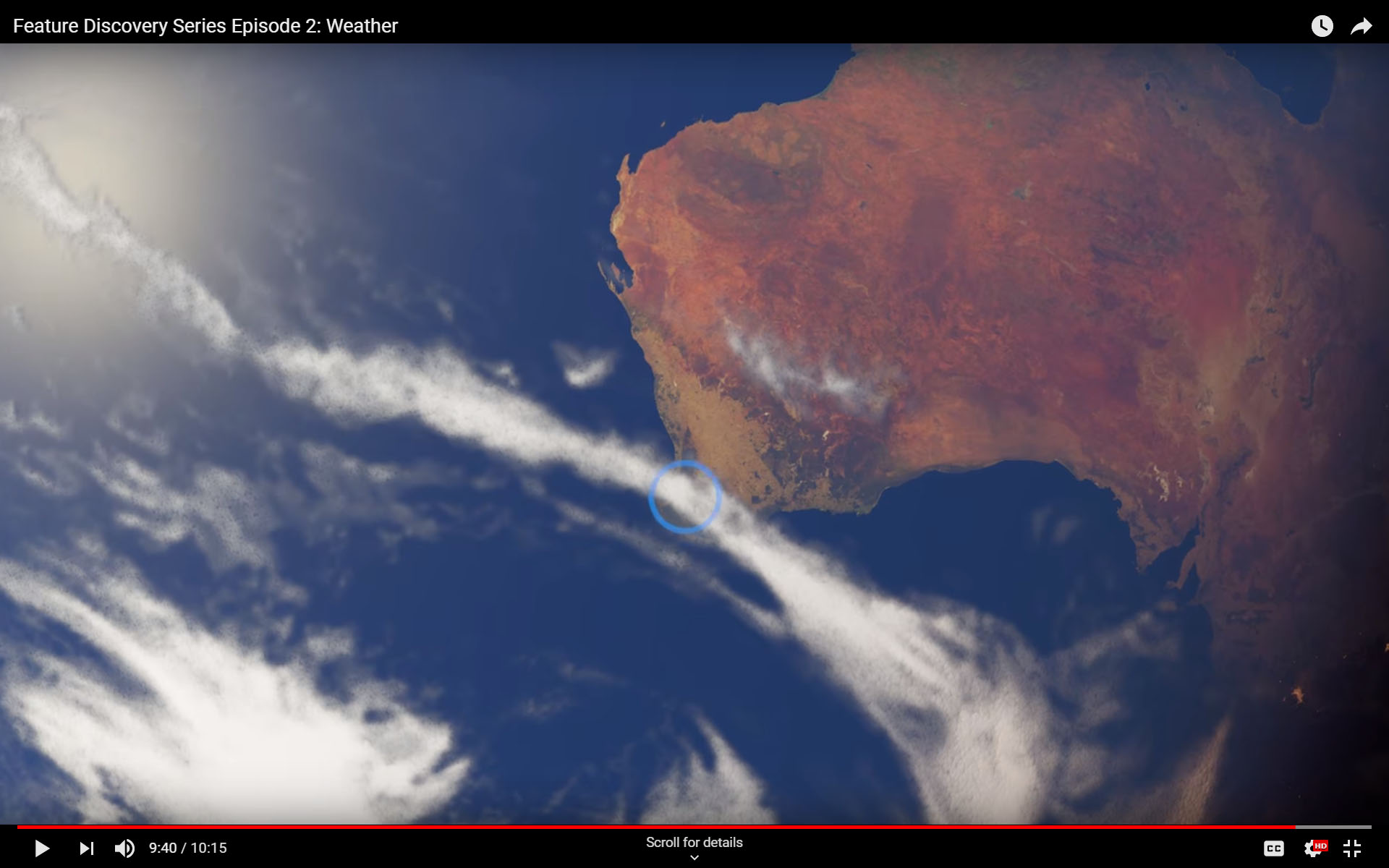
The next shot (above) is pretty spectacular: It clearly shows the landmass of Western Australia from orbital height. There are a few things that are truly exciting about this shot: First, the land mass is rendered with a much better and natural looking land coverage. It is looking far less generic (as it is in FSX's case) and far more random and natural. Moreover, there is (finally) cloud coverage from orbital heights!!! And not just random cloud coverage - this is REAL TIME WEATHER data, and the clouds are then procedurally generated to depict the correct cloud type, coverage, altitude, etc.
The next image is truly impressive - it is a zoomed-in region of the area inside a blue circle in the above image:
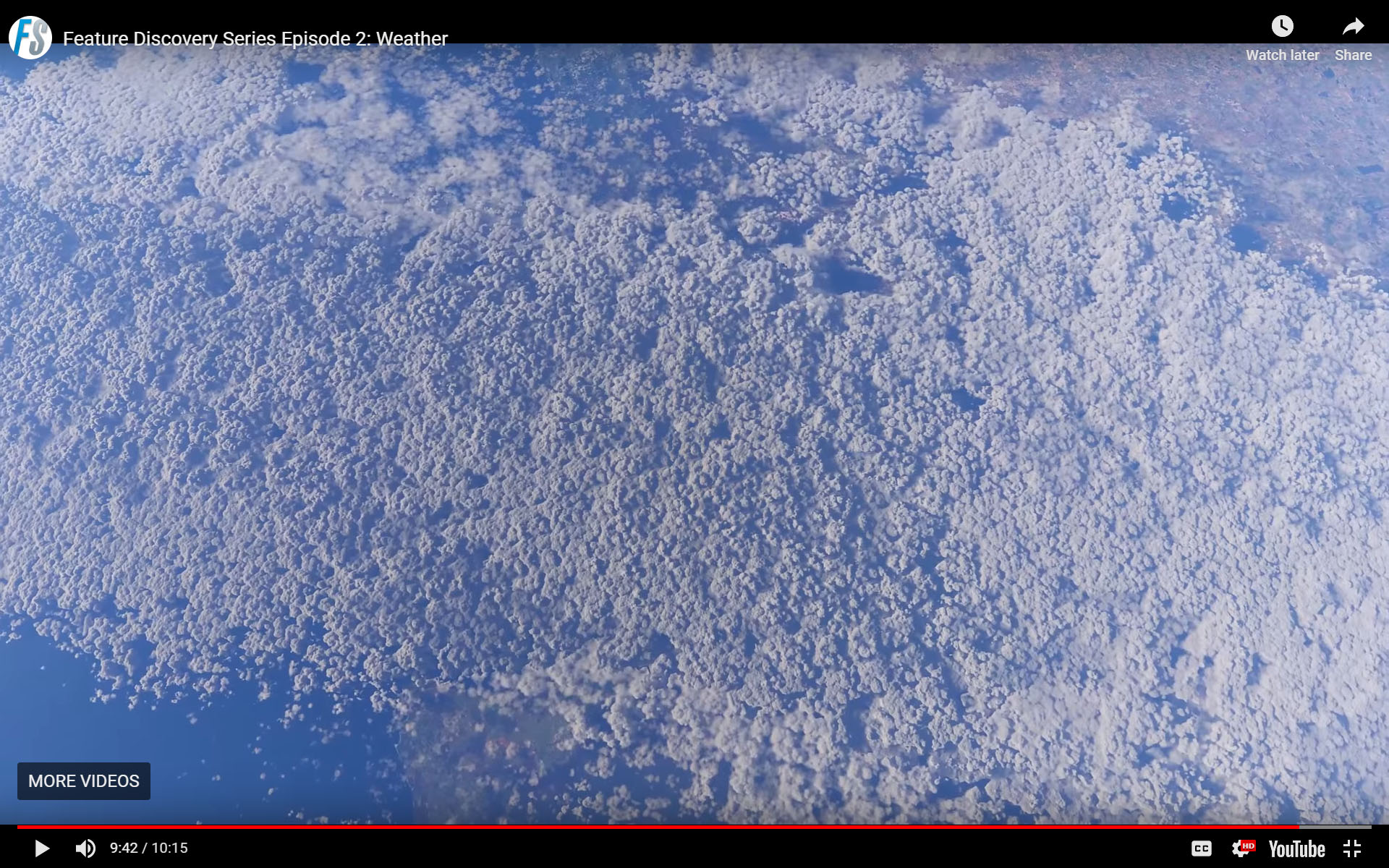
These are 3-D cloud puffs as seen from orbit! All rendered with shadows casting on the ground, AND onto the clouds themselves. If this is the sign of what is being developed, the vista from the orbit will be truly spectacular! We cannot wait to enjoy a spacewalk in LEO, with this kind of imagery zipping below us - the experience will be breathtaking!
Analysis of what FS2020 developers are revealing
As many of you may know by now, Microsoft has announced the successor to the highly acclaimed FSX, along with the series of legacy Flight Simulators derived from FSX. The new simulator will be titled (appropriately) FS2020, (or, FS dos equis, for FSXX, as some simmers have started calling it
). We have been following with great interest the progress of the development, and we tried to scoop technical details that might pertain to what hopefully will be a follow up to FSX SpacePort - a version compatible with FS2020.While the visuals are undeniably stunning, what MS has shown off so far was within atmosphere, where spaceflight dwells for mere minutes. On October 24th, MS has posted the latest development video, where they describe the weather system in FS2020. In it, there are a few quick video sequences of weather from a very high altitude, and, to our delight, a sequence from orbital altitude! Let's take a look at what they reveal:
This first shot (above) is taken from a very high altitude, perhaps 20 to 30 km, and it shows a visual acuity far into the horizon. This is great from the aspect that the weather seems to have a lot bigger coverage than it had in FSX, where above 30 or so km, you can clearly see a "box" of weather (clouds) under the spacecraft. At orbital heights, The weather has to be turned off because it is just a small patch close to the ground that follows spacecraft, and the rest of the planet has no weather at all. We were always unhappy with how this looked and were searching for alternate solutions.
The next shot (above) is pretty spectacular: It clearly shows the landmass of Western Australia from orbital height. There are a few things that are truly exciting about this shot: First, the land mass is rendered with a much better and natural looking land coverage. It is looking far less generic (as it is in FSX's case) and far more random and natural. Moreover, there is (finally) cloud coverage from orbital heights!!! And not just random cloud coverage - this is REAL TIME WEATHER data, and the clouds are then procedurally generated to depict the correct cloud type, coverage, altitude, etc.
The next image is truly impressive - it is a zoomed-in region of the area inside a blue circle in the above image:
These are 3-D cloud puffs as seen from orbit! All rendered with shadows casting on the ground, AND onto the clouds themselves. If this is the sign of what is being developed, the vista from the orbit will be truly spectacular! We cannot wait to enjoy a spacewalk in LEO, with this kind of imagery zipping below us - the experience will be breathtaking!

- Messages
- 2,231
- Country

Hey Misho  long time no see!
I hope you are doing good, I just wanted to know how the SpacePort project is going (especially regarding MSFS, if you had time to look at it)
I definitely switched to MSFS to be honnest, I really wish to see SpacePort working on this new Sim ^^
Regards
long time no see!I hope you are doing good, I just wanted to know how the SpacePort project is going (especially regarding MSFS, if you had time to look at it)
I definitely switched to MSFS to be honnest, I really wish to see SpacePort working on this new Sim ^^
Regards
- Messages
- 1,057
- Country
Hi Marc!
Covid has slowed things down a bit, but I've picked up the pace in the last few weeks! I've been really hoping to release a new demo version by Christmas, but that will probably not happen for at least a few weeks now. As far as MSFS2020, as it stands, things don't look promising because the absolute aircraft height limit seems to be 85 km, and that's not even the edge of space. But who knows, maybe there is some kind of an altitude limit override, depending on the object type.
On the bright note, I am preparing P3D version (64 bit) vor P3D v4 and v5!! I have the base code in, I just have to adjust the installer details (which are far less complicated in P3D than for FSX). I will work on P3D version after I produce FSXA/FSX-SE versions.
Covid has slowed things down a bit, but I've picked up the pace in the last few weeks! I've been really hoping to release a new demo version by Christmas, but that will probably not happen for at least a few weeks now. As far as MSFS2020, as it stands, things don't look promising because the absolute aircraft height limit seems to be 85 km, and that's not even the edge of space. But who knows, maybe there is some kind of an altitude limit override, depending on the object type.
On the bright note, I am preparing P3D version (64 bit) vor P3D v4 and v5!! I have the base code in, I just have to adjust the installer details (which are far less complicated in P3D than for FSX). I will work on P3D version after I produce FSXA/FSX-SE versions.
- Messages
- 2,231
- Country
Hey Misho!
Yeah, COVID slowed everything...
Something you can do is to ask Asobo to upper the limit/tell you if/how you can override the limit (Unlike FSX, its supported; Unlike P3D, the Devs are Listening to Users)
I personally dropped FSX (Still installed, in case you need a tester on this one ) Now Using MSFS, (feel free to DM me if you need a tester for it) About P3D, I simple dont have it (MSFS was announced just in time xD)
Take Care, Stay Safe and Healthy
Yeah, COVID slowed everything...
Something you can do is to ask Asobo to upper the limit/tell you if/how you can override the limit
(Unlike FSX, its supported; Unlike P3D, the Devs are Listening to Users)I personally dropped FSX (Still installed, in case you need a tester on this one
) Now Using MSFS, (feel free to DM me if you need a tester for it) About P3D, I simple dont have it (MSFS was announced just in time xD)Take Care, Stay Safe and Healthy
